PHASE IT
A gamified goal-based app to help ex-addicts from relapsing after rehab

Project Details
Team:
Vanshika Sanghi, Rashi Balachandran, Sohayainder Kaur
Duration:
10 days
Brief: To focus on the typical design cycle which includes ascertaining user needs beyond user interfaces and conceptualizing across-the-board experiences.
Overview
Phase it is a gamified goal-based app to help former alcohol addicts ease back into normalcy after visiting a rehab facility and tackling the stigmas that come with being an ex-addict. The objective was to build an interface that fulfils the user's needs beyond an interface.
Phase it explores the possibilities of new methods of interactions with ex alcohol -addicts after their experience in rehab. Their areas of struggle include consistency of control after they leave rehab, and structuring a routine where basic activities can be hard and demotivating. There is a need for support and empathy from the individuals around them, which will help in restructuring relationships that have been earlier affected and redefine the stigmas that come with being an ex-addict.
The project examines the journey addicts embark upon post-rehab, and aims to give the process structure and incentives to help them ease back into normalcy taking their loved ones on the journey with them, to create a more wholesome and more empathetic mindset.
Objective
To understand what drives addiction, the ex - addict's process of rehabilitation and recovery and what mindset the patient's family and friends have during this process.
User Research
Interviews
To gain a deeper understanding of the community, we set out to interview people who were comfortable speaking about their experiences and fight against addiction. But it was a challenge to find individuals who would be willing to speak with us as anonymity is a given when it comes to talking about addiction.
Interviews were conducted with:
1.Ex - alcohol addicts
1. Their immediate family members
2. Their friends
We conduced 6 interviews, along with some secondary research, it gave us more insight into what are the challenges ex-addicts face, through personal stories and past experiences they have had
Key Research Insights
-
There is a stigma attached to addiction in India. They need to lie about their past in order to get equal job opportunities or romantic partners.
-
While rehab centre's house addicts for approximately 3-5 weeks, the remaining process depends heavily upon the patient’s willingness to attend AA meetings, stick to a strict routine, and avoid any substance or other temptations. The failure to do this is why patients often relapse.
-
People are often in denial of it and refuse to be admitted to rehab centre's. Most of them are there not by choice. Through this attitude, their families are deeply affected.
-
Addiction can affect the patient's relationships, especially those of family. Patients say that they had to work to re-establish feelings of trust, faith and love with their families to attain normalcy back in their households.
Personas
From our research, we create 5 primary user personas to understand user behaviours, perceptions, and goals.


Opportunity Areas ( How Might We's)
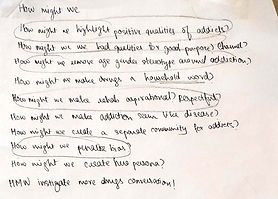
After analyzing the personas and our insights we started on the ideation process, where we used the crazy 8's brainstorming method to come up with different ideas along with how might we's to define some questions we wanted to answer.



How might we?
Instill confidence in ex-addicts
Highlight positive qualities of ex - addicts
Accessible and Inclusive
Penalise bias
Trigger Conversation
Built trust for their families
Remove age, gender sterotypes
Restoring normalcy after rehab
Remove social stigma
Make it subtle
Open up opportunities for ex-addicts
Ethical
Change perceptions on rehab as a place of rehabilitation not shame
Empathetic approach
Sensitive
Upon reviewing our ideas we decided on some design goals & trigger questions that we thought were crucial for our final experience. The main goals included establishing
Trust
Normalcy
Empathy
How might we penalise bias
Keeping these pointers in mind, we conducted a brainstorming session to ideate on the outcome and its medium.


Concept Iterations
An experiential simulation, to understand and view the public biases (good and bad) towards ex-addicts.
The social experiment is conducted by placing a person who has not experienced any addiction with an ex alcohol -addict amidst a daily scenario, where one can view their behavior and emotions towards them. It aims to create a moment of reflection, along with generating awareness about ex-addicts.
The reason for this method being a social experiment is because addiction is a highly human emotion, an area technology does not aid well, as they often create distance where they mean to connect. Thus trying to keep the experience real, where true feelings of empathy and understanding can appear in a more organic manner. Addiction is a highly personal and sensitive matter, involving a lot of perceptions, emotions and subjectivity and we didn't think technology would do the cause justice.
However, this process tends to shame the public for their biases regarding ex-addicts, where the intention was for them to reflect on their misconceptions. This creates a loop of judgment, instead of breaking away from it, it adds more negative connotations to this already negative mix
A gamified, goal-based motivation app that tries to rebuild the connection between the ex - addict and his family. It also acts as a self-motivator. This design intervention aims to simplify the process of recovery, including their families in the mix to mend relationships after the way they had been left before in the form of an app. The initial weeks of recovery and integration are crucial and require discipline, routine and healthy distractions, and family support. The app facilitates the process by providing gentle reminders and steady motivation for all members involved to make the process more fun and full of activities towards recovery.
In doing so, it invites conversations and effort between family members, normalizes a healthy home environment, and helps the addict understand themselves during recovery.
Experience Mapping
We aimed for this experience to be impactful and affect the environment and surroundings of the individuals using it, thus we tried to priorities the quality of the experience over the medium. In order to not restrict ourselves to a single medium, we outlined the exact experience we wanted to create and let that guide us to the medium most fit to its needs. This way it allowed us to be more creative and explorative of our options and tools we could use to create.

The user experience was divided into 9 phases depicting the evolution of the usage of the app by the patient and their close ones. It showed how this app usage throughout the long recovery process would create a gradual experience, with slowly changing emotions, attitudes, and behaviors over time.

From this experience mapping, we ideated on choosing our medium, we thought of subscription-based services, add on to the newspaper, a calendar, a digital screen? We wanted it to be more personal and something that is on you all the time, hence we decided to go with our medium to be an app and a tangible calendar with it.
Face it with Phase it
‘Phase It’ is a gamified, goal-based app that aids the recovery process for ex-addicts out of rehab, by assisting in building trust and empathy between them and their immediate loved ones, creating a support system that will gradually lead to a healthy routine and normalcy back into their lives.
Features
provides achievable goals for all members involved
Phase it requires the patients to tackle one stage at a time, each stage consists of goals that need to be completed before they can move to the next stage. Some goals are short term to build motivation and confidence and some larger long term can help in forming a routine. These goals are custom made, from a questionnaire the family needs to answer when they retrieve the patient from the rehab centre. This way the goals are personal and cater to the patient's preference. The app is provided by the rehab centre to prevent their patients from relapsing, after leaving a controlled facility. On achieving these goals it provides the patients with points, to incentivise usage there are points simply to open the app as well. On noticing long intervals of no activity the app sends alerts to remind one of their daily goals. These alerts reduce when it detects noticeable activity on the app.
Make family crucial for the recovery process
The goals often involve the entire family and need to be completed through group efforts, this helps the family spend more time together and find value in each other. Success in spending family time is also marked on the calendar amounts to the goals that need to be achieved. The ultimate aim is for the candidate to complete all 3 levels , to see considerable impact on their self-worth, familial bonds, and social comfort have improved. The calendar provides the family with motivation and a sense of achievement, which will encourage them to continue more diligently. It is also easier for the patient as they are not in the process alone they have the love and support of their family.All these factors help in guiding a more sensitive approach towards the patient by their families, to increase their confidence so they can integrate back into society and have a healthy routine. To keep track of the progress, the physical calendar comes with stickers that mark victories of tasks where one can see the overall development of the patient.


Phase its recovery plan has 3 stages
Rebuilding
Family Time
Social Bird
The goals often involve the entire family and need to be completed through group efforts, this helps the family spend more time together and find value in each other. Success in spending family time is also marked on the calendar amounts to the goals that need to be achieved. The ultimate aim is for the user to complete all 3 levels such that normalcy is restored in their life, and their self-worth, familial bonds, and social comfort have improved. The calendar provides the family with motivation and a sense of achievement, which will encourage them to continue more diligently. It is also easier for the patient as they are not in the process alone they have the love and support of their family
Wireframing
Low Fidelity


High Fidelity


Feedback
Because of the feedback we got, we decided to rework some aspects :
1. We re-made our customer journey map with storyboarding to make it more readable and add an emotional timeline as well.
2. Creating proper wireframes after the rough sketches.
3. Worked on changing a few wireframes from our final Adobe XD work. In the future we would like to expand the app so it works for other addictions as well, we would also want to include people with different support systems and economic backgrounds and some others from the feedback we received.
